
By Art Cooksey, Founder and CEO, Let's Talk Interactive
Two out of three people booked into an American jail have a substance use disorder. Nearly half have been told by a clinician they have a mental illness. Within a year, one in five is booked again. Jails have become the country's largest behavioral health system, and they are paying for it twice: once in the bed, and again when the same person comes back.
Here is the arithmetic a jail administrator can take to the county commission.
The hospital run
Every off-site medical trip takes two officers off the floor, often on overtime. Los Angeles County measured the security and vehicle cost at $1,500 per transport; North Carolina's prisons put the median trip at $1,631. Nevada's corrections department logged 93,000 overtime hours in one year for medical transports and hospital posts, with 67 officers a day at hospitals, 45 of them unbudgeted.
Four of five of those trips are a round trip. Across 733,000 emergency visits by incarcerated adults, 80% were treated and released. Hours of officer time to deliver a person to a waiting room and bring them back.
The officer pays too. New York's prison staff averaged 432 hours of overtime each in 2025. Oklahoma's corrections union says its members' top complaint is not being able to be with their families. Roughly a third of officers report PTSD symptoms. Forced overtime for a hospital post is where a lot of that starts.
Not every trip is avoidable. The share that is has been measured: Los Angeles County resolved 25% of specialty consultations without a transport once a remote specialist could review the case; two neighboring counties cut unnecessary specialist trips by 57%.
How fast they come back
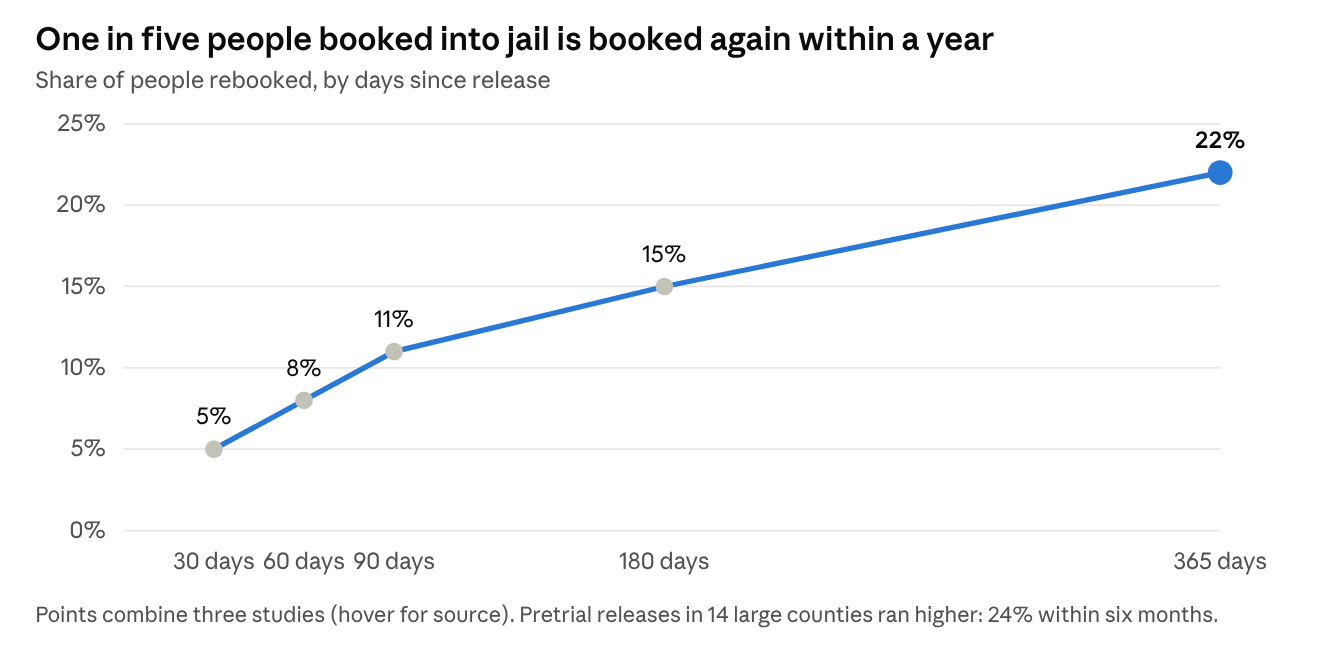
Share of people rebooked by days since release. Sources: NYU Public Safety Lab / Council on Criminal Justice (2020), Allegheny County DHS (2014), Prison Policy Initiative (2024).
In a national sample of 170 jails, 5% of people released were booked again within 30 days, 8% within 60 and 11% within 90. The largest recent study, 648 jails, found 22% rebooked within a year. A small group drives the churn: in Allegheny County, people with four or more bookings in a year were almost certain to return, and three-quarters of them had used mental health services before.
The weeks after release are also the deadliest. People leaving custody are more than ten times as likely to die as the general population, mostly from overdose.
What works
Seven Massachusetts jails began offering medication for opioid use disorder. Among 6,400 people, those treated in jail had 52% fewer fatal overdoses after release and 12% less reincarceration; 60% connected with community treatment within 30 days, against 18% of those not treated. That last number is the mechanism: care that starts inside and continues outside. Enrolling people in Medicaid at release alone cut one-year reincarceration by about one-sixth in Wisconsin.
The barrier jails name most often is licensed staff. Fewer than half offer any addiction medication; only 13% offer it to everyone who needs it. A kiosk in the housing unit and a licensed provider on screen is how a 500-bed jail gets psychiatry on a Saturday night without hiring a psychiatrist.
The math for a 500-bed jail
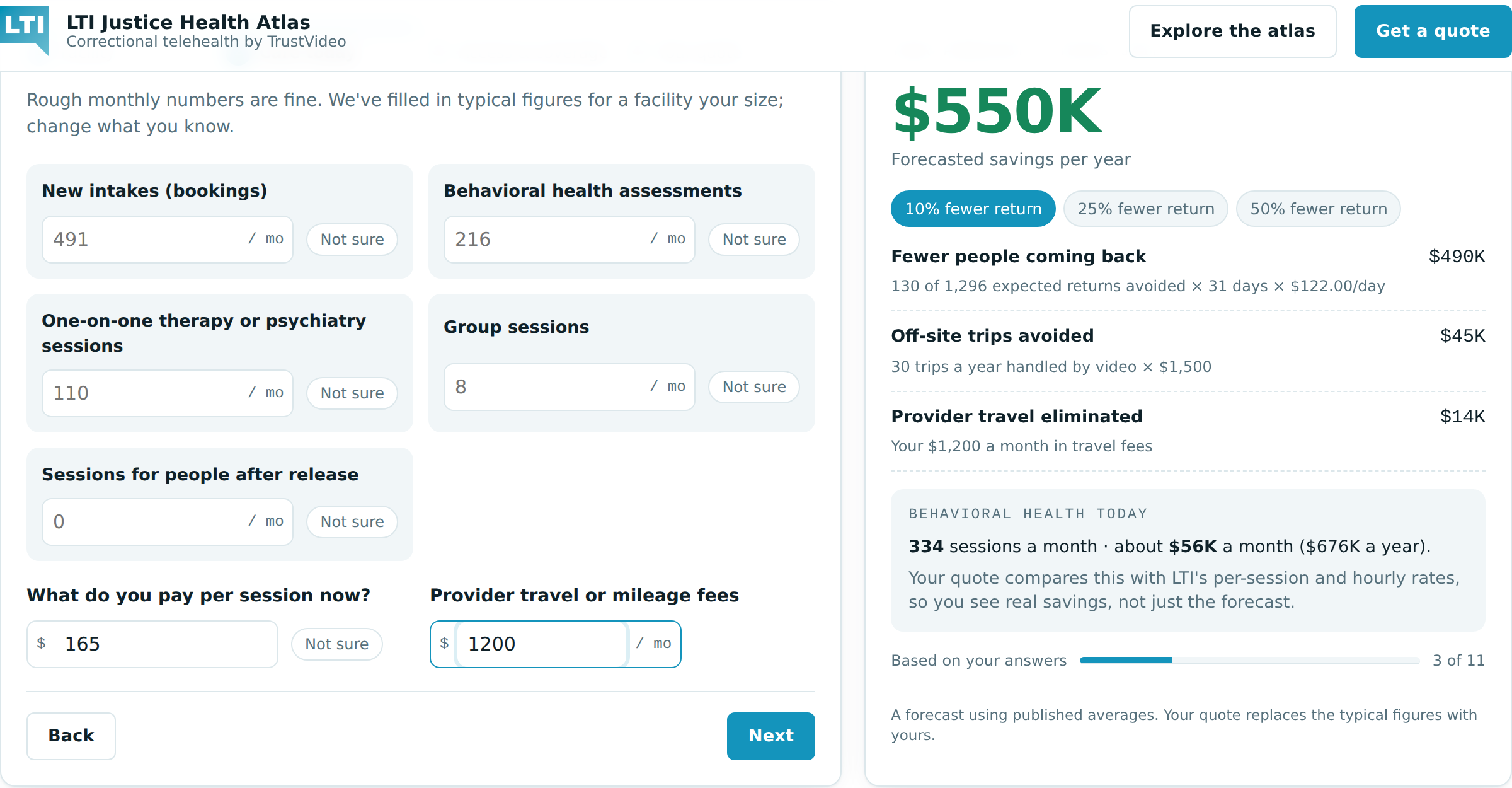
The reduction estimator turns a facility's own numbers into a forecast and a quote request.
| Lever | Assumption | Yearly cost avoided |
|---|---|---|
| Off-site trips handled by video | 120 trips a year, 25% resolved remotely at $1,500 | $45,000 |
| Provider travel eliminated | 3 trips a week, 2 hours round trip at $150 an hour | $53,000 |
| Fewer people coming back | 5,900 releases, 22% rebooked, 10% fewer returns, 31 days at $122 | $490,000 |
| Total | about $590,000 a year |
These are avoided costs at average daily rates, not budget cuts, and the 10% is deliberately below what the studies achieved. Not in the table: about 60 two-officer trips returned to the housing units, and everything outside the jail budget, from emergency visits to a family's rent.
At national scale, roughly $16.5 billion of the $116 billion spent on corrections each year pays for people coming back. Ten percent fewer returns is about $1.8 billion a year and 175,000 fewer people cycling through jail.
Two objections, answered
"Telehealth is already in our medical contract." Often it is, on paper. Ask your vendor three questions: what is the wait for a routine psychiatric appointment, what happens at 2 a.m. on a Saturday, and who sees the person after release. LTI's providers plug into an existing contract for the gaps it leaves: after-hours crisis coverage, intake screening on the day of booking, specialty consults that would otherwise be a transport, and the same clinician continuing after release. You pay by the hour or the session for what the contract doesn't cover.
"The court orders those transports, not me." Court trips are not the target. The avoidable trips are medical: the specialist consult that could be a video visit, the emergency room visit for a condition a nurse and a remote physician could manage on site, the psychiatric evaluation that waits until a provider drives in. Those are the trips your transport log can count, and they are the ones that come back the same day.
Run your own numbers
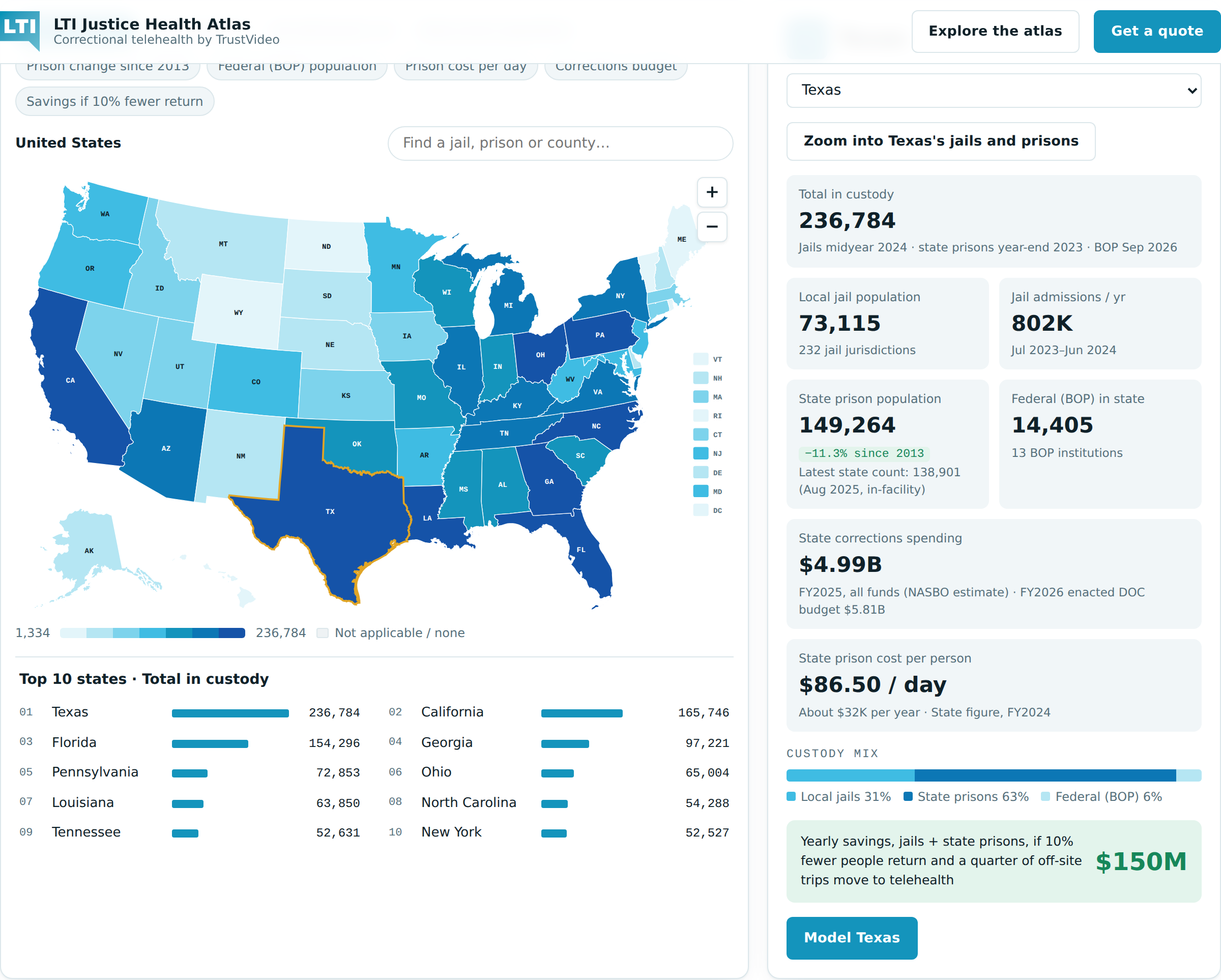
The LTI Justice Health Atlas shades every state by custody count, budget or cost per day, and zooms to any county.
The LTI Justice Health Atlas shows the custody count, budget and cost per day for every state and county. The reduction estimator takes three minutes and returns a forecast on the spot; LTI follows up with a quote that compares what you pay today with licensed remote providers, crisis coverage, kiosks, the TrustVideo platform, insurance billing where coverage exists, and a follow-up program after release.
Jails are funded by the number of people they hold. The people inside, the officers who guard them and the families waiting for both would be better served if they were funded by the number who don't come back. Until then, the math above is the next best argument.
Three levers for a legislator. Medicaid reentry waivers now let 21 states and D.C. bill Medicaid for care in the 90 days before release. Opioid settlement funds can pay for medication and follow-up in jails in most states. And a one-year pilot clause in a jail medical contract, with transports and rebookings as the measures, costs nothing to write.